Your Direct Mail Readiness Checklist: Is It Time to Diversify Your Marketing?
November 17, 2025
TL;DR
If your digital channels are plateauing while CAC rises and engagement drops, that’s a saturation signal — and often the first sign it’s time to diversify with direct mail.
The best early wins come from mid-funnel triggers (cart/browse abandonment, stalled repeat purchase, lapsed windows) where a physical touchpoint cuts through inbox fatigue.
You’re only ready to launch if your first-party data is clean: accurate addresses, deduped lists, validated deliverability, and enough volume to segment beyond a single “all customers” list.
Creative readiness matters as much as data, you need print-ready assets, a real personalization plan, and a testing mindset to avoid generic mailers that don’t convert.
Direct mail should be treated like a performance channel, which means defining KPIs up front and using trackable codes/URLs/QRs with real-time reporting.
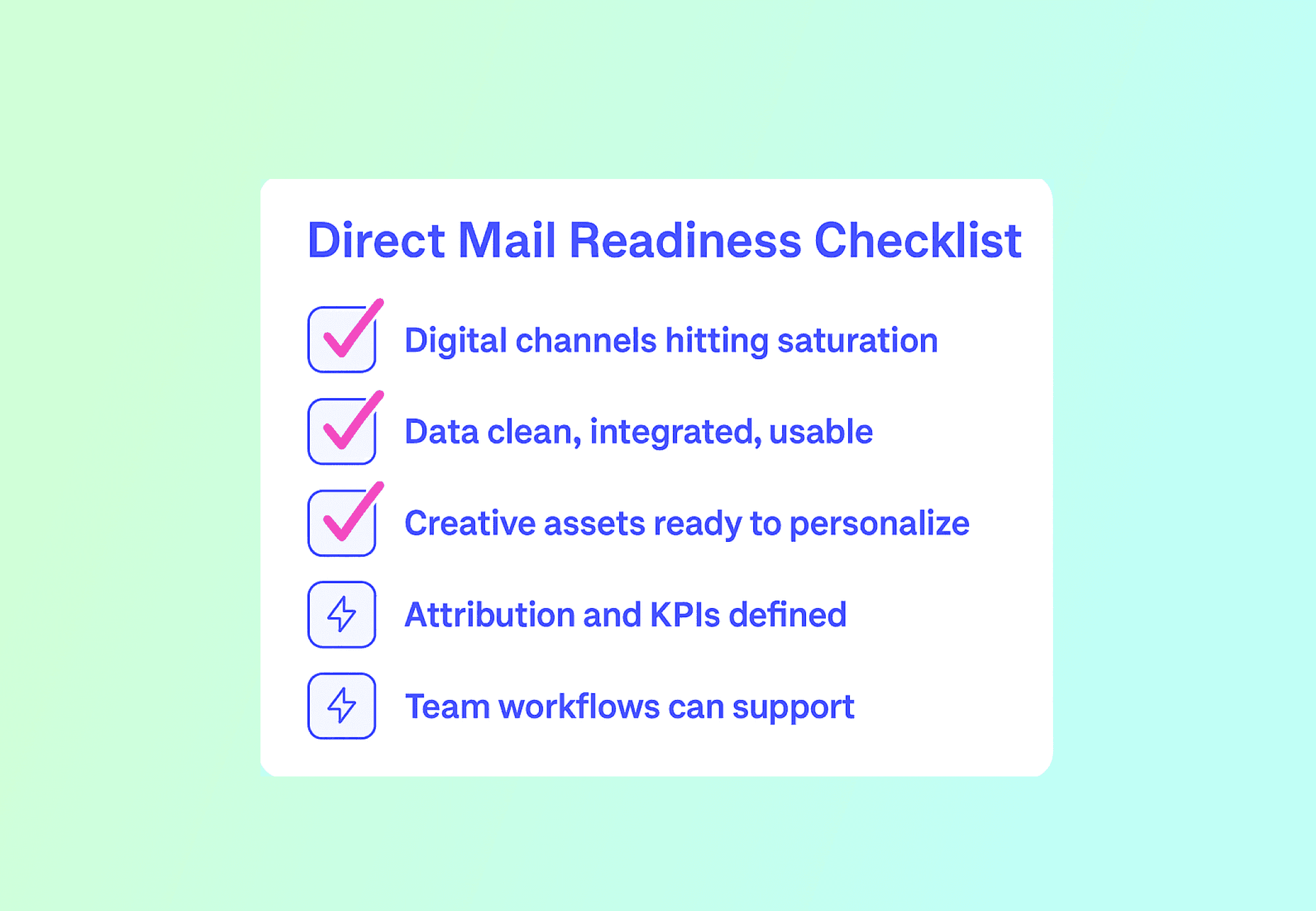
Start with a focused pilot, prove baseline ROAS, and scale only once your data, creative, measurement, and team capacity boxes are checked.
Your digital channels didn’t stop working overnight — they slowly got louder, more crowded, and less responsive. If your email, paid social, or search performance has started to plateau while costs climb, that’s not a creative problem. It’s a saturation problem. And it’s the clearest signal that your channel mix needs a new lever.
Direct mail has become that lever for modern growth teams because it cuts through digital fatigue and can now be measured and automated like any digital channel. But not every brand is ready to launch it profitably on day one. This checklist will tell you if you are — across the four things that determine direct mail ROI: market signals, data and integrations, creative readiness, and attribution. By the end, you’ll know exactly whether you should add direct mail now, and what to fix first if you’re not there yet.
Is Your Digital Marketing Hitting a Wall? The First Signal for Direct Mail Readiness
Successful direct mail often starts with one clear signal: digital channel saturation. When existing channels show diminishing returns and audience fatigue, it’s a sign your audience is becoming numb to your current outreach. This is the moment to consider a new channel that can cut through the noise.
1. Your digital channels are showing saturation.
You can recognize the clear signs of digital fatigue in your own dashboards. Look for:
A steady decline in email open and click-through rates, even among your most engaged segments
Rising unsubscribe rates after campaigns that used to perform
Increasing CAC on paid social and search without a comparable lift in CLTV
Performance plateaus even when creative, targeting, and budgets stay consistent
These metrics aren’t isolated issues. They’re signals that your message is getting lost in an overcrowded digital space, and that your current channels are no longer giving you incremental lift.
2. You have high-intent mid-funnel moments to trigger direct mail.
The most effective place to introduce this physical touchpoint is at key mid-funnel moments, especially:
Cart abandonment
Browse abandonment
A stalled repeat-purchase window
A lapsed-customer threshold (e.g., no order in 60–90 days)
High-intent triggers like these are prime opportunities for re-engagement.
3. You understand why direct mail works better at these moments.
When a customer ignores a cart abandonment email, sending a second and third email often does more harm than good, leading to unsubscribes. A well-timed postcard with a compelling offer, however, can reactivate that purchase intent far more effectively. It’s an unexpected and premium touch that reminds them of the value they left behind. Modern platforms are built to simplify and automate these exact workflows, turning them into an effortless part of your lifecycle strategy.
Is Your Data Ready for Direct Mail? A Comprehensive Checklist for Audience & Integrations
Successful direct mail starts with clean, segmented first-party data and a simple way to activate it. Before you send anything, you need to be sure you can reach the right person, at the right address, with the right message, otherwise your campaigns won’t have the precision required for real ROI.
The good news: BirdseyePost handles the data hygiene for you. We can pull and sync your lists directly from Shopify or Klaviyo through integrations, or you can upload a CSV. From there, our team cleans and prepares your list end-to-end, so you don’t have to turn this into an internal data project before launching.
Direct mail data readiness checklist:
1. Your first-party data is ready.
Before you send a single piece, confirm you have:
Clean customer lists with accurate, complete postal addresses
A reliable way you collect address data (checkout, lead forms, in-store signups, events)
Enough volume to segment meaningfully (not just one master list)
A plan to responsibly append missing addresses if needed
If your address data is sparse, evaluate appending methods, but prioritize data collected directly from your customers, because it’s the most reliable.
2. Data hygiene is covered (and BirdseyePost takes it off your plate).
Data hygiene is non-negotiable, and it’s something BirdseyePost takes off your plate. Before launching any campaign, we make sure:
Your lists are de-duplicated to avoid sending multiple pieces to the same household
Addresses are validated and formatted correctly
Outdated or incomplete records are scrubbed
Deliverability checks are in place to reduce returned mail
This groundwork maximizes deliverability and ensures you don’t waste budget on mailers that never reach their destination.
Is Your Creative Engine Primed? The Checklist for Personalized Mailer Design and Assets
Your brand needs strong creative and a real personalization plan to launch direct mail that converts. A mailer’s success depends heavily on its design and messaging, a visually compelling, on-brand piece with a relevant offer will always outperform a generic send.
If you don’t have print-ready creative capacity in-house, BirdseyePost fills that gap: our in-house creative team can design your postcards for you end-to-end, or you can upload your own finished design. If you’re starting from scratch, you can also choose from our ready-to-use templates and we’ll customize them to match your brand.
Begin with a quick asset audit. Confirm you have:
High-resolution product photography
Vector logos and brand marks
Brand fonts and type hierarchy
Clear brand guidelines (including color hex codes)
Any past mailers or templates you can repurpose
Next, confirm you can personalize beyond a first name. You should be able to:
Feature recommendations based on browsing or category interest
Tailor offers by segment (VIP vs. first-time vs. lapsed)
Send a clear “we miss you” incentive when customers fall out of rhythm
That’s what elevates direct mail from a broadcast medium to a precision marketing tool.
Can You Measure the Impact? Your Checklist for Direct Mail Attribution and KPIs
To treat direct mail like a real performance channel, you need attribution you can trust, and you shouldn’t have to build it yourself. BirdseyePost provides the tracking layer and reporting automatically, so every mailer is measurable from day one.
Direct mail measurement readiness checklist:
1. You know what success looks like.
Before you send, align on the goal and the metric that proves it. We’ll help you set the right KPIs for your campaign, such as:
Response rate
Conversion rate
ROAS
Incremental lift in CLTV (for retention sends)
2. Your mailers are trackable end-to-end.
BirdseyePost campaigns come with built-in offline-to-online tracking. We set this up for you using:
Unique promo codes
Custom URLs / dedicated landing pages
Trackable QR codes on every postcard
3. You can see performances in real time.
You get a live dashboard showing scans, visits, conversions, and attributed revenue, broken out by segment, creative, and offer, so you can optimize future sends with confidence.
And because this visibility is built in, every campaign gets smarter over time, you can scale what works and fix what doesn’t, fast.
Is Your Team Positioned for Success? Operational Capacity and Workflow Readiness
Your team’s workflows and bandwidth need to support a direct mail program, unless you choose a full-service partner that handles the operational lift. Use this checklist to confirm you’re set up to launch smoothly.
1. You have clear ownership.
Someone on your team is accountable for direct mail strategy and results (even if execution is outsourced).
2. You have bandwidth for the core tasks.
You have time and coverage for:
List management and segmentation
Creative briefs and asset coordination
Approval workflows
Send scheduling and calendar alignment
Performance monitoring and reporting
3. Your process won’t bottleneck.
Creative and segmentation decisions can move quickly enough to support testing and iteration, not one-off sends.
4. You’re not stretching a maxed-out team.
If your team is already at full capacity, adding direct mail without support risks slow launches, missed optimizations, and burnout.
5. If you don’t have the bandwidth, you have the right partner.
For teams with limited time or resources, a platform offering end-to-end campaign management can be the most efficient path to market. Instead of just providing software, these partners act as an extension of your marketing team. With BirdseyePost, you get full-service campaign management on every plan, at no extra cost . This means an expert handles your strategy, audience setup, creative production, and reporting, allowing you to launch a sophisticated program without the internal overhead.
What Are the Financials? Understanding Direct Mail Pricing and ROI Expectations
Before you commit to direct mail, make sure the economics work in your favor. You don’t need a big budget to start, but you do need a clear path to proving ROAS, understanding your true cost per send, and scaling without friction.
Direct mail financial readiness checklist:
1. You can fund a small pilot first.
Direct mail doesn’t require a massive upfront investment. A targeted test to a few hundred or a thousand recipients is usually enough to establish baseline response, conversion, and ROAS.
2. Pricing is transparent and all-inclusive.
When evaluating partners, look for a clear cost-per-piece that includes printing, postage, data processing, and support — so you know your real unit economics from day one.
3. There are no hidden barriers to testing.
Avoid models with platform subscriptions, setup fees, or high minimums that make pilots expensive, slow, or unnecessarily risky.
4. Costs scale efficiently.
Your cost-per-piece should stay predictable whether you’re sending small, automated lifecycle drops or larger campaigns, so you can scale confidently as results prove out.
If You’re Checked In, You’re Ready to Send
If you've checked most of the boxes in this guide, from identifying digital fatigue to confirming your data, creative, and measurement capabilities, you are ready to add direct mail to your marketing mix. The path to launching a successful program is clearer than ever. By confirming you have the foundational elements in place, you can move forward with confidence.
Modern platforms have removed the traditional barriers, making direct mail as measurable, automatable, and performance-driven as any digital channel. The key is to start with a clear strategy, a targeted audience, and a partner equipped to help you execute and measure from day one. You no longer have to choose between tangible impact and trackable data; today’s direct mail delivers both.
Launch your first automated direct mail campaign with confidence. Book a demo with BirdseyePost to see how simple it is.
FAQ
What’s the clearest sign it’s time to add direct mail?
If your core digital channels are showing saturation, declining email engagement, rising CAC, or performance plateaus despite steady effort, that’s the strongest timing signal. Direct mail works best as the next lever when your audience is numb to more digital touches.
Do I need a huge list or big budget to start direct mail?
No. A small, targeted pilot (a few hundred to a few thousand recipients) is usually enough to prove baseline response, conversion, and ROAS. The point is to validate performance before you scale.
What if my address data isn’t perfect yet?
You don’t need flawless data to begin, but you do need a clean foundation. BirdseyePost helps by pulling lists from Shopify or Klaviyo (or accepting a CSV) and handling de-duping, address validation, formatting, and responsible appending where needed, so you’re not stuck doing manual list cleanup first.
Do I need an in-house designer to launch high-performing mailers?
Not at all. If you have your own creative, you can upload it. If you don’t, BirdseyePost’s in-house creative team can design postcards for you end-to-end, or start from proven templates and customize them to your brand.
How do I know direct mail is working once I launch?
Direct mail should be measurable like any digital channel. BirdseyePost builds tracking into every campaign (QR codes, custom URLs, promo codes) and gives you real-time dashboards showing scans, visits, conversions, and attributed revenue — so you can optimize fast and scale what works.