Design That Converts: The Psychology Behind High-Performing Direct Mail
November 19, 2025
TL;DR
Direct mail fails when design is treated as decoration instead of a conversion system, attention, clarity, and CTA drive everything.
High-performing postcards share core ingredients: a bold headline, targeted imagery, tight benefit copy, a strong offer, and a frictionless CTA.
Color and hierarchy aren’t aesthetic choices; they’re behavioral cues that shape emotion, urgency, and how fast people “get it.”
Personalization and relevant visuals increase recall and response because the piece feels meant for them, not “everyone.”
The mailbox-to-browser bridge matters: smart QR/PURL tracking turns offline interest into measurable online action.
BirdseyePost closes the loop by pairing expert creative with ScanCapture™ data, so every send teaches you what to improve next.
The Direct Mail Visibility and Design Gap BirdseyePost Was Built to Solve
Ineffective direct mail often stems from a lack of strategic design and measurable attribution, a gap BirdseyePost closes by integrating design psychology with trackable campaign performance. For decades, many businesses treated direct mail as an untrackable, volume-based tactic. The approach was to "spray and pray," sending thousands of generic postcards with aesthetically pleasing but strategically weak creative, hoping that some of it would stick.
Without a foundational understanding of design psychology, these mailers are destined to fail before they even reach the mailbox. They break down in predictable ways:
They don’t capture attention in the critical first few seconds.
Their message gets lost in visual clutter.
The call-to-action is unclear or uninspiring.
They drive low response rates and wasted ad spend.
They reinforce the outdated belief that mail doesn’t work.
They generate zero actionable data to improve future campaigns.
The cost isn’t just the printing and postage; it’s the opportunity cost of not connecting with high-intent customers in a meaningful way.
The core challenge for today's growth and lifecycle marketers is to elevate direct mail from this generic, untrackable past into a modern, conversion-focused performance channel. We need our physical mailers to deliver the same level of granular data, testability, and measurable ROI that we demand from our email, SMS, and paid social campaigns. It’s about moving beyond assumptions and into a world of data-backed creative decisions.
This is precisely the gap BirdseyePost was built to bridge . Our platform transforms direct mail into a fully measurable performance channel. We provide the integrated software, design expertise, and end-to-end fulfillment that allows marketers to deploy psychologically-driven, personalized creative and track its impact on revenue with digital-level precision.
How to design an effective direct mailer postcard?
An effective direct mail design is a strategic conversion tool, not just a piece of branded material. Its success is built on a foundation of psychological principles that influence recipient behavior, combining compelling visuals, a clear message, a prominent call-to-action (CTA), and meaningful personalization. It respects the recipient's time by being instantly scannable and communicates a single, compelling idea that prompts immediate action.
The essential components of a high-converting design are engineered to work together seamlessly:
A powerful headline that grabs attention
High-quality imagery that resonates with the target audience
A concise, benefit-driven message
An irresistible offer
A clear, unmissable call-to-action (CTA)
A frictionless path from the mailbox to the next step (QR code, URL, or PURL)
When these elements are in perfect alignment, they create a direct, intuitive path to conversion. A failure in any one of these areas can break the chain and result in the mailer being discarded.
The most successful direct mail campaigns are deeply rooted in proven psychological principles that enhance recall, engagement, and ultimately, conversion. Concepts like color theory, visual hierarchy, and dual-coding are not abstract academic ideas; they are practical tools that marketers can use to make their mailers more memorable and persuasive. By understanding how the human brain processes visual and tactile information, we can design postcards that don't just get seen—they get results.
BirdseyePost simplifies the creation of these high-impact designs through expert creative support and powerful automation tools. Our platform and in-house team help you translate these psychological principles into tangible, high-performing mailers that drive measurable growth for your business.
The Power of Color: How Hues Influence Emotion and Action in Your Mailers
Strategic color application profoundly impacts direct mail effectiveness by tapping into psychological triggers that influence emotion and action. Because color heavily shapes first impressions, a well-chosen palette is essential for grabbing attention, establishing brand identity, and guiding the recipient toward your offer. The right colors can make your mailer feel urgent, trustworthy, luxurious, or energetic, directly aligning the creative with the campaign's core objective.
A strategic color palette does more than just make a postcard look good; it serves a functional purpose. High-contrast colors can be used to make your CTA pop off the page, ensuring it's the first thing a recipient sees. A consistent brand palette helps build recognition and trust over time.
For example:
A wellness clinic might use calming greens and blues to evoke a sense of health and tranquility.
An ecommerce brand running a flash sale would leverage bold reds and oranges to create urgency and excitement.
BirdseyePost has an in-house creative team that designs your direct mail for you. Our studio applies proven color psychology to build, test, and refine high-performing templates on your behalf, so every postcard you send is both unmistakably on-brand and engineered to convert.
If you’re dealing with internal creative bottlenecks, we step in as your design arm. We collaborate with your team to develop conversion-focused color palettes and layouts that match your brand guidelines and campaign goals, delivering ready-to-send creative without requiring you to hire or manage a large in-house design team.
Guiding the Eye: Visual Hierarchy and Layout Rules for Higher CTA Conversions
An optimized visual hierarchy is what directs a recipient's attention to your most important message, dramatically improving CTA conversion. By applying Gestalt principles—a set of laws describing how humans perceive visual elements as a unified whole—designers can create a clear, intuitive path for the eye to follow. This ensures your headline, offer, and CTA are seen first and in the correct order, all within a matter of seconds.
In practice, a strong visual hierarchy relies on three core tools:
Proximity: Group related items—like placing your offer directly next to your CTA—to create a clear association.
Contrast: Use size, color, or shape to make the most important element (usually the CTA) stand out from everything else.
White space: Intentionally reduce clutter so the eye lands on the key message fast.
A well-executed hierarchy eliminates confusion and makes it effortless for the recipient to understand what you're offering and what you want them to do next.
The BirdseyePost design team applies these principles to every creative we help build. We understand that a postcard is not a brochure; it's a billboard that has three seconds to make an impact. Our layouts are intentionally structured to guide the user's eye from the headline to the offer and finally to the QR code or URL. This methodical approach to design turns a simple piece of cardstock into a highly efficient conversion machine.
More importantly, our platform allows you to rapidly iterate and test these printed layouts to measure the real-world impact of different hierarchies. You can A/B test a version with a large, centered headline against one with a prominent image to see which generates more scans. This allows you to validate creative hypotheses with actual performance data, continuously optimizing your mailers for higher engagement and ROI.
Connecting Visually: Imagery, Personalization, and Unforgettable Recall
Combining personalized imagery with clear copy is one of the most powerful ways to amplify recall and drive engagement. This strategy is grounded in dual-coding theory, which posits that memory is enhanced when the brain stores information in both visual and verbal forms. According to this theory, a relevant image paired with corresponding text creates a much stronger and more durable memory trace than text alone. When a recipient sees a picture of a product they like alongside its name, the message becomes far more memorable.
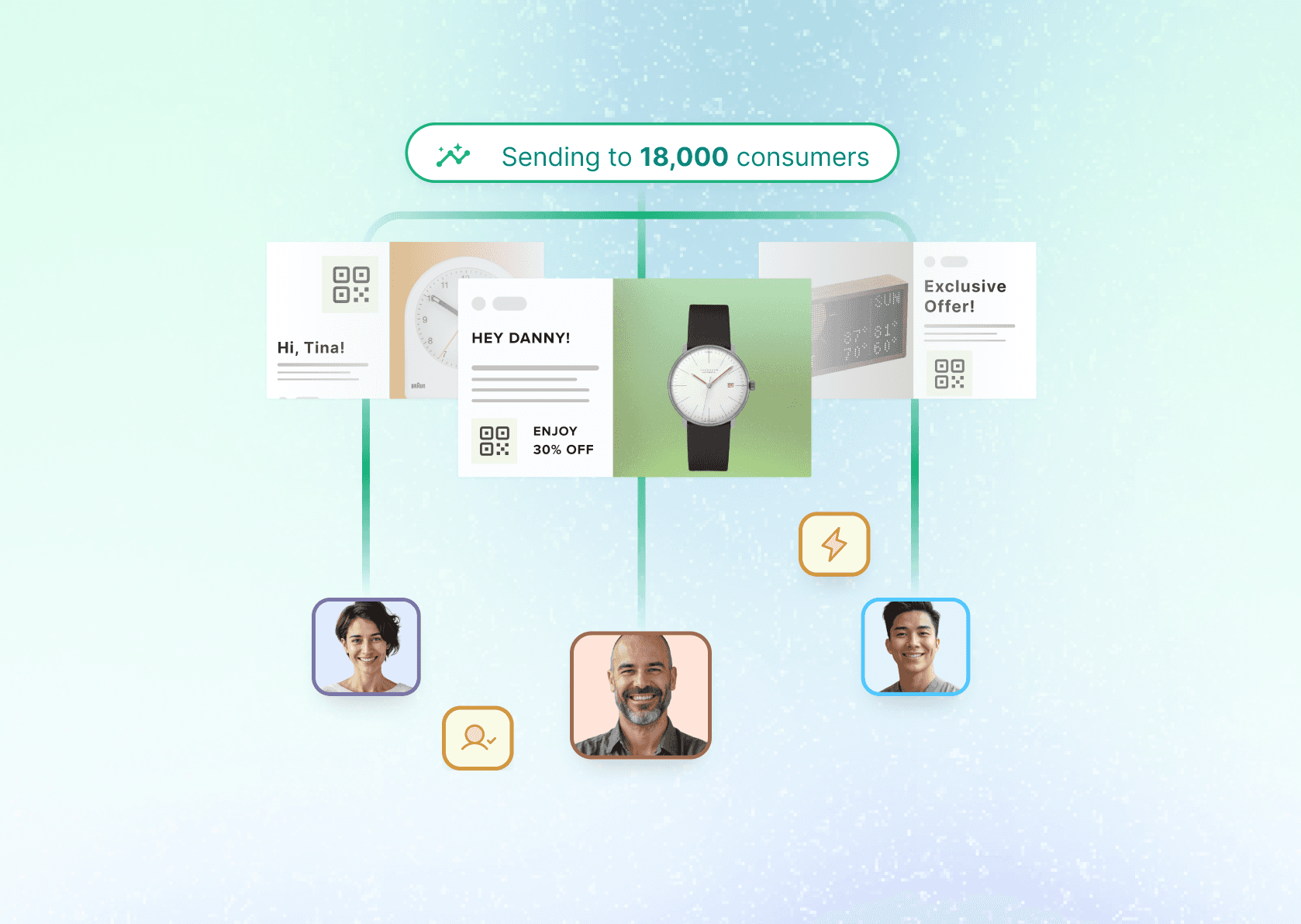
Personalized imagery takes this principle a step further, making the mailer hyper-relevant to each individual. For an ecommerce brand, this could mean dynamically inserting a picture of a product the customer recently viewed or left in their shopping cart. For a real estate agent, it could involve featuring a photo of a home that just sold on the recipient's street. This level of personalization signals that the message is specifically for them, transforming a piece of marketing into a relevant, one-to-one communication.
BirdseyePost's platform is built to enable this kind of sophisticated personalization at scale. By integrating with your CRM, ecommerce platform, or other data sources, we can automatically personalize each mailer with relevant product images, names, offers, and other dynamic content. This process happens seamlessly within our workflow, allowing you to send tens of thousands of unique mailers as easily as you would a single generic one.
This capability ensures that every recipient receives the creative most likely to resonate with their specific interests and behaviors. By combining the psychological impact of dual-coding with the relevance of personalization, you can create unforgettable mailers that drive direct action.
From Mailbox to Mouse Click: Bridging the Offline-to-Online Gap with Smart Design and Tracking
Intelligent design bridges the offline-to-online gap by embedding trackable digital links directly into the physical mailer. Using elements like QR codes and PURLs (Personalized URLs) transforms a postcard from a static print piece into a measurable, interactive touchpoint that seamlessly connects the physical and digital worlds.
Including these trackable links is proven to increase response rates and provide rich attribution data . Every scan of a QR code or visit to a PURL is a first-party data signal that tells you your mailer is working. This data can include the exact time of engagement, the geographic location of the scan, and the type of device used, providing invaluable insights into customer behavior and campaign performance.
BirdseyePost’s proprietary ScanCapture™ technology is the engine that closes this attribution loop. We generate a unique, dynamic QR code for every single postcard we send. When a recipient scans the code, we capture that interaction and tie it directly back to the specific mailer and the customer who received it. This provides definitive, one-to-one attribution, allowing you to see exactly who is responding to your campaigns.
This granular data is a game-changer for optimization. You can finally move beyond vanity metrics and measure what truly matters: scans, website traffic, and attributed conversions. By tracking which creative variations, offers, and audience segments drive the most engagement, you gain the insights needed to systematically refine your strategy. You can definitively prove the ROI of your direct mail spend and make data-driven decisions to improve the effectiveness of every future campaign.
Optimizing for Impact: BirdseyePost's Continuous Optimization Process
BirdseyePost transforms direct mail design from a one-time creative task into a continuous, data-driven optimization loop. By using an iterative testing framework, our process systematically improves campaign performance over time. The result is a predictable growth channel built on real learnings, not assumptions.
Hypothesize: It starts with a strong, data-backed premise. Instead of guessing what might work, our fully managed campaigns, our AI engine, to analyze your customer data and identify high-potential opportunities. You get a clear starting point—like a win-back offer targeting customers who haven’t purchased in 90 days.
Test: Rather than committing your full budget to a single creative, you run controlled A/B tests on small, representative segments. You can test different images, headlines, offers, or CTAs to see which variant performs best before scaling.
Measure: Using ScanCapture™, you track real-world performance with digital-level precision. Your dashboard shows scan rates, click-through rates, and attributed conversions so you can identify a statistically significant winner based on hard data.
Refine and scale: Once a winning design is clear, you roll it out across the larger audience with confidence. The insights from that test feed the next hypothesis, creating a loop that makes every send smarter than the last.
This cycle of continuous improvement ensures your direct mail campaigns become progressively more effective over time.
Conclusion: Design Is Not an Expense, It’s Your Conversion Engine
By combining psychological design principles with measurable automation, you can transform direct mail from an outdated marketing tactic into a high-performing revenue channel. Strategic design isn't a discretionary expense; it's the core engine that captures attention, communicates value, and drives conversions. When every element—from color and layout to imagery and tracking—is optimized, your mailers deliver a clear and predictable return on investment.
Moving from generic, untrackable mailers to data-driven, personalized campaigns is the single most important shift a modern brand can make in its direct mail strategy. This evolution drives higher engagement, better conversion rates, and, most importantly, measurable ROI that you can report back to your team with confidence. It’s the difference between spending money and investing it.
BirdseyePost empowers you to implement these sophisticated direct mail strategies without the traditional complexity. Our all-in-one platform makes a historically cumbersome process simple, automated, and fully trackable from end to end. We provide the tools, expertise, and support needed to turn your creative ideas into high-impact campaigns that deliver results.
It's time to stop guessing and start measuring. Stop treating direct mail as a cost center and start building it into a predictable revenue driver. With a focus on designs that convert, you can unlock the full potential of the physical mailbox as a powerful channel for customer acquisition and retention.
Ready to see how data-driven design can transform your direct mail performance? Schedule a demo with BirdseyePost today.
FAQ:
How important is color in direct mail design?
Color is crucial because it immediately impacts a recipient's emotional response and perception of your brand. A strategic palette helps your mailer stand out in a stack of mail, reinforces brand identity, evokes specific feelings like trust or urgency, and can be used to guide the eye directly toward your call-to-action, significantly influencing response rates.
Can direct mail design be personalized at scale?
Absolutely. Modern platforms like BirdseyePost connect directly to your customer data sources, such as your CRM or ecommerce store. This integration allows you to automatically customize each mailer with relevant information like product images the customer has viewed, their name, or a unique offer, which dramatically boosts relevance and conversion rates without manual effort.
How can I measure the effectiveness of my direct mail design?
Effectiveness is measured by including trackable elements directly in the design. BirdseyePost's ScanCapture™ technology uses unique QR codes printed on every mailer. When a recipient scans the code, we link that physical mailer to a digital action, giving you clear, one-to-one attribution data on scan rates, website traffic, and attributed sales.
Is managing the printing process for custom designs difficult?
It can be incredibly difficult if you're managing multiple vendors, but all-in-one platforms solve this problem entirely. BirdseyePost manages the complete workflow, from design approval and variable data printing to mailing and delivery. This integrated approach removes all logistical complexity, allowing your team to focus on campaign strategy and creative optimization instead of print management.