MedSpa Membership Renewals by Mail: The 3-Touch Sequence
July 31, 2026
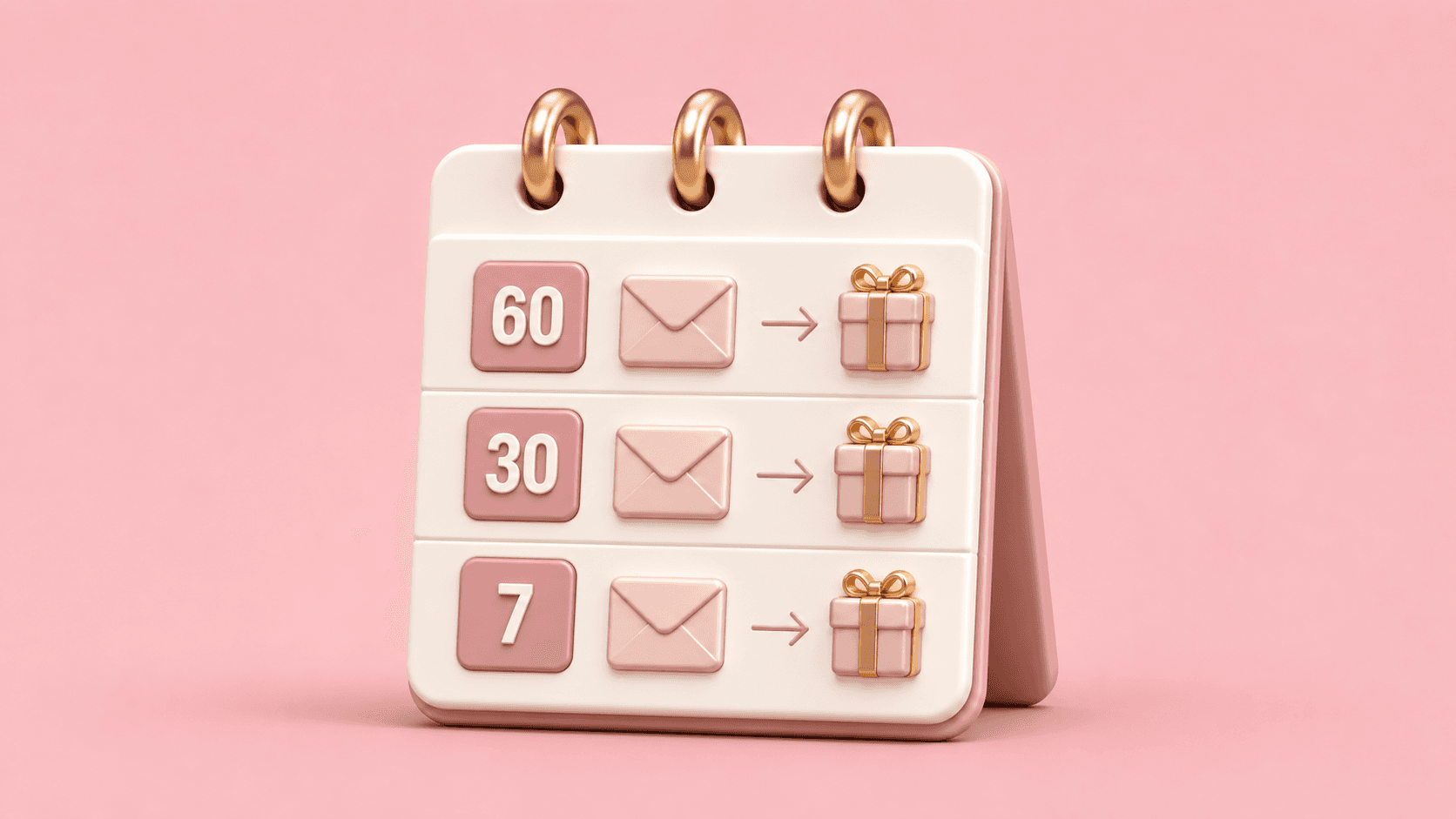
Every membership has an expiry date you can see coming. Yet most medspas treat renewals as a scramble, reacting after a member lapses instead of acting before. That's backward. Your strongest medspa marketing asset isn't a new-patient acquisition campaign. It's the members who already pay you every month. This guide gives you a dated, three-touch renewal sequence that reaches members at 60, 30, and 7 days before expiry, anchored by physical mail and closed with a scan-to-book QR code.
The sequence is the point. Copy it, adapt the offers to your tiers, and run it off each member's expiry date.
Why Membership Renewals Are Your Highest-ROI Mail
Renewals protect the revenue you already earn, and defending revenue costs far less than chasing new revenue. Research by Frederick Reichheld at Bain & Company found that increasing customer retention rates by just 5% can lift profits by 25% to 95%, depending on the industry. That finding still holds, and the gap has only widened: customer acquisition costs have climbed roughly 60% in the last five years, according to Paddle's analysis of nearly 700 subscription companies, driven by iOS privacy changes, cookie deprecation, and tighter regulations. Every retained customer is worth more now than when Reichheld first ran the numbers.
For a medical spa, the math is stark. Medical aesthetics is a $17 billion industry growing by more than $1 billion a year, according to the American Med Spa Association's 2024 State of the Industry report, and membership programs turn a share of that into predictable, recurring income. Every member who renews compounds. They book more treatments, refer friends, and cost almost nothing to keep compared with the paid ads it takes to replace them.
Membership renewal is not a side project. It's the highest-return mail you can send, because even a small lift in your renewal rate flows straight to profit.
Why the Renewal Touch Should Be Physical
Mail gets seen. Email gets buried. Direct mail earns a 4.4% average response rate, roughly 36 times higher than email's 0.12%, according to the ANA/DMA Response Rate Report, and house lists of existing customers respond at 5% to 9%. Your members are the warmest house list you own.
Physical mail also matches the brand. A member paying for injectables and facials expects a premium experience, and a heavy, well-designed renewal card reinforces that the relationship is worth keeping. A renewal email competes with dozens of unread messages. A card sits on the counter for days.
That doesn't mean you drop email and text. Use them as reinforcement. Mail is the anchor touch that gets opened, and email and SMS echo the offer so it's easy to act. This piece focuses on renewals. If you also want to reduce no-shows and keep chairs full between visits, see our guide to appointment reminder postcards.
The 3-Touch Renewal Sequence
The sequence fires on three dated touches before a member's expiry: an early nudge at 60 days, the core offer at 30 days, and an urgency close at 7 days. Each touch has one job.
Touch | Timing | Goal | Offer logic | Copy direction |
|---|---|---|---|---|
Touch 1 | 60 days pre-expiry | Thank and remind | Early-renewal perk (bonus treatment or add-on) | Warm and appreciative; "your membership renews soon, here's a reason to lock it in early" |
Touch 2 | 30 days pre-expiry | Present the core offer | The renewal terms, framed by value received this year | Value-first; recap treatments used and dollars saved, then state the renewal offer |
Touch 3 | 7 days pre-expiry | Create urgency and close | Deadline reminder, no new discount | Direct and time-bound; "your benefits end [date], scan to renew in 30 seconds" |
Touch 1 (60 days): thank and remind. Open with appreciation, not a sales pitch. Remind the member their term renews soon and offer a small early-renewal perk, such as a complimentary add-on or bonus session, for renewing ahead of the deadline. The goal is to catch the members who would happily renew but simply forget.
Touch 2 (30 days): the core offer. This is the workhorse. Lead with value the member already received: treatments booked, dollars saved versus non-member pricing, milestones hit. Then present the renewal clearly. When someone sees what they got, the renewal reads as continuing a good deal rather than paying another bill.
Touch 3 (7 days): urgency and the scan-to-book close. Keep it short. State the deadline, restate the core benefit, and put a QR code front and center. A member should scan the card, land on a prefilled renewal or booking page, and finish in under a minute. Do not add a new discount here. Urgency does the work, and stacking a bigger offer just trains members to wait.
Offer Laddering by Tier
Match the renewal offer to the member's tier so you reward loyalty without discounting people who would renew anyway. A flat "20% off to renew" hands margin to your most committed members for no reason.
Entry-tier members: Use a modest incentive to overcome inertia, such as a bonus service or a small add-on credit that raises perceived value without cutting the dues price.
High-tier and VIP members: Reward status, not price. Offer early access to a new treatment, a members-only event, or a premium gift. Send these renewals in an upgraded format, such as a heavier card stock or a folded, envelope-enclosed piece, so the touch itself signals that you value the relationship.
Spend your incentive budget where it changes behavior. Members already inclined to renew need recognition and a frictionless path, not a coupon.
Measuring Renewal Performance
Measure renewals the same way you measure paid channels: renewal rate, cost per renewal, and revenue per piece. Start with the benchmark math. If 200 memberships expire this quarter and 150 renew, your renewal rate is 75%. Lift that to 80% and, at typical membership economics, the added dues drop almost entirely to profit, which is exactly why the retention math above matters.
Attribution has always been the hard part. Per-recipient tracking changes that. When each renewal card carries a QR code tied to the individual member, a scan tells you exactly who engaged, which touch drove the action, and whether it ended in a booked renewal. BirdseyePost's SnapCapture™ does this. Every postcard gets a unique code linked to the recipient, and scans sync back to your booking or marketing system so you can attribute renewed revenue to the specific card that earned it.
That individual-level data lets you A/B test across the sequence. Try two offers in Touch 2, compare renewal rates by tier, and cut the touches or formats that do not pay for themselves.
Automating It From Your Booking or CRM System
The sequence should run itself off each member's expiry date. Manually pulling lists and mailing cards every week doesn't scale, and it's exactly the kind of task that slips when the front desk gets busy.
With BirdseyePost, the expiry date auto-enrolls the member into the sequence. The three touches fire on schedule at 60, 30, and 7 days out, using SmartMailers™, which trigger postcards off lifecycle events the same way your email flows do. When a member scans and renews, that action writes back to your system and suppresses the remaining touches, so nobody gets a "renew now" card after they already renewed. Penny, our AI agent, handles the setup alongside human design and strategy support, so a lean team gets set-and-forget renewal protection instead of another weekly chore.
The result: recurring revenue defended automatically. A member approaches expiry, the sequence runs, and most renew before they ever think about leaving.
FAQs
When should a medspa membership renewal sequence start?
Start 60 days before the membership expires. That gives you room for three touches, an early reminder at 60 days, the core offer at 30 days, and an urgency close at 7 days, without crowding the member. Starting earlier risks the reminder feeling premature, and starting later leaves no time to win back a member who's on the fence.
How many touches does it take to renew a member?
Three physical touches, reinforced by email and text, work well for most medspas. Membership organizations that report the highest renewal rates use multi-touch sequences rather than a single reminder, and a dated 60/30/7-day cadence covers the forgetful, the undecided, and the last-minute renewer without over-mailing.
Is direct mail better than email for renewals?
For the renewal anchor, yes. Direct mail's roughly 4.4% average response rate far outpaces email's 0.12%, and mail to an existing house list responds at 5% to 9%. Email and SMS still matter as reinforcement, but the physical card is what breaks through and matches a medspa's premium brand.
How do you track whether a mailed renewal actually worked?
Put a unique QR code on each card tied to the individual member. When they scan to renew or book, you capture who acted, which touch drove it, and the revenue that resulted. This individual-level attribution lets you calculate cost per renewal and A/B test offers across the sequence instead of guessing.
Renewals shouldn't be a quarterly fire drill. They should be an automated sequence that runs off the expiry date, anchored by mail your members actually open and closed by a scan you can measure. Build your medspa membership renewal rate the way you build the rest of your marketing: triggered, personalized, and tied to revenue.