Appointment Reminder Postcards: The No-Show Math Text Alone Misses
August 19, 2026
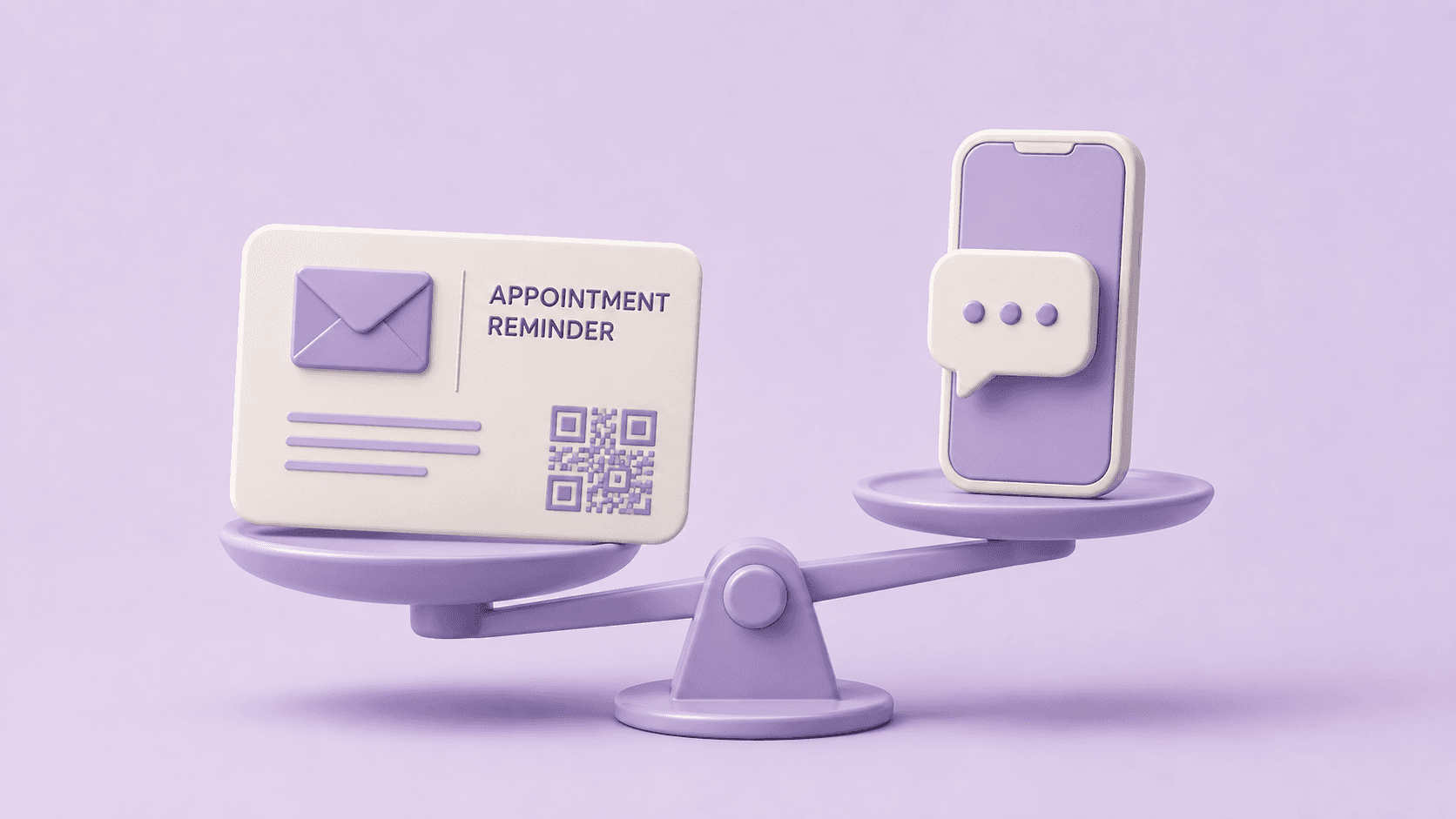
One missed appointment costs a clinic $150 to $300 in lost provider time, and that's before you count the staff hours to rebook the slot. You already text. You already email. So why is your no-show rate stuck?
The answer is reminder fatigue. Appointment reminder postcards solve a problem your text sequence can't: they reach the overdue patients who've tuned out your digital messages. This isn't mail versus text. It's mail plus text, and the math favors stacking.
What One No-Show Actually Costs Your Clinic
A single no-show costs most practices $150 to $300 in lost provider time. Peer-reviewed research puts the most-cited figure at $196 per missed appointment, measured across ten VA clinics, and a common vendor benchmark values each unused 60-minute slot at roughly $200.
That's the visible cost. The hidden cost is labor: front-desk staff time to notice the gap, call the waitlist, and rebook. For a single-chair dental practice or single-room medspa, an empty slot can't be resold like an airline seat. It's gone.
No-show rates vary widely by specialty. Here's what the published data shows.
Clinic type | Typical no-show rate | Annual drag on one chair/room* |
|---|---|---|
Primary care | 19% | ~$18,000 |
Dental | 15% | ~$14,000 |
Dermatology | 30% | ~$28,000 |
Optometry | 25% | ~$23,000 |
Medspa / elective | 15–25% | ~$14,000–$23,000 |
*Illustrative: assumes ~10 booked slots/day, 250 operating days, and $196 lost per missed slot. Rates drawn from compiled no-show research by specialty.
Even at the low end, a 15% no-show rate drains five figures a year from one provider. Cut that rate by a third and you've funded the recovery program several times over.
Why Text-Only Reminders Plateau
Text reminders work. Until they don't. SMS gets a 90%+ open rate, but opens aren't actions. Appointment reminders typically pull 65% to 85% response rates, and that number drops on the second and third message as patients start skimming and ignoring.
Three forces cap what text alone can do:
Reminder fatigue. The first text lands. The second gets a glance. By the third, many patients pattern-match it to spam and swipe it away.
Opt-out and deliverability decay. Under FCC rules, patients can reply STOP at any time, and once they do, that channel is closed. Wrong numbers, full inboxes, and carrier filtering thin the reachable list further.
Selection bias. Digital reminders skew toward patients who already engage, the ones who were likely to show anyway. The patient who ghosted? Odds are they muted your texts months ago.
That last point matters most. Text is great at confirming near-term appointments for engaged patients. It's weak at reactivating the patients who stopped coming. And those inactive patients are where the recoverable revenue sits.
What a Physical Recall Card Does Differently
A recall card interrupts a pattern that a text can't. It's a physical object on the counter or the fridge, not another notification in a muted thread.
First, distinguish two jobs most software blurs together:
A reminder is near-term: "your cleaning is Thursday at 2." It confirms an existing appointment.
A recall is for the overdue or dormant patient: "you're due for a visit, and we haven't seen you." It restarts a lapsed relationship.
Text handles reminders well. Recall is where mail earns its keep. Three reasons:
Dwell time. Advertising mail stays in the home an average of 17 days, according to RetailWire data cited by the U.S. Small Business Administration. A text is gone in seconds. A dated card sits on the fridge as a standing cue every time someone walks past.
Response lift. Direct mail averages a 4.4% response rate versus 0.12% for email, per the ANA/DMA Response Rate Report, and mail to a house list of your own lapsed patients runs 5% to 9%. Reactivation pulls the highest response rates because the relationship already exists.
The dated trigger. A card that reads "you were last seen in March, book by June 30" creates a deadline a passive text notification doesn't. It gives the overdue patient a reason to act now.
For dental teams working dormant charts specifically, we go deeper in our guide to patient winback for wellness clinics. The stacking logic in this piece holds whether you run chairs or treatment rooms.
The Channel-Stack: Mail for Recall, Text for Confirmation
Stop pitting mail against text. Give each channel the job it does best, then sequence them. Mail wakes up the overdue patient; text confirms once they've booked.
Here's a concrete cadence that works for most clinics:
Overdue + 30 days: drop the recall card. Once a patient passes their recommended recall window by 30 days, trigger a dated postcard with a clear "book by" date.
On booking: confirmation text. When they book, ideally by scanning the card, a text confirms the slot and sets the reminder track.
Appointment − 72 hours: reminder text. Standard near-term confirmation to lock in the show.
Appointment − 24 hours: final text. The last nudge, where two-way SMS lets them confirm or reschedule.
The card starts the sequence; text finishes it. Neither channel carries the whole load, and each covers the other's blind spot.
The catch with mail has always been measurement, and that's the part worth fixing next. Put a per-recipient QR code on every card so a scan ties back to a specific patient, then to a booking. Without it, mail is a guess. With it, mail is a line item you can track the way you track everything else.
Stop Choosing. Start Stacking.
Your no-show rate is stuck because you're asking one channel to do two jobs. Text confirms the patients who were going to show. It can't reach the ones who stopped listening. Appointment reminder postcards do, and a per-card QR code makes every recovered booking countable.
The play is straightforward: mail the recall, text the confirmation, measure recovered appointments per card. Run it for one recall cycle and compare the rebooked slots against your card cost. The math usually makes the case on its own.
That's what BirdseyePost does. It triggers recall cards straight from your CRM, prints a unique QR code on each one, and reports per-recipient scans and bookings in a single dashboard. Mail stops being the untrackable channel. Want to see it in action? Book a demo.
FAQs
What's the difference between an appointment reminder and a recall card?
A reminder confirms a near-term appointment a patient already booked ("your visit is Thursday"). A recall card targets an overdue or dormant patient who has no upcoming appointment ("you're due, book by June 30"). Text handles reminders well; mailed recall cards are stronger for reactivating lapsed patients.
Do appointment reminder postcards actually reduce patient no-shows?
They reduce the no-shows text alone can't reach, the overdue and disengaged patients who've tuned out digital messages. Mail to a house list of your own lapsed patients runs 5% to 9% response versus 0.12% for email, and the physical card's 17-day average dwell time keeps the prompt visible. Used alongside text confirmations, mail closes the gap in your recall funnel.
How do you measure ROI on mailed appointment reminders?
Print a unique QR code on each card so a scan ties to a specific patient and a specific booking. That gives you one-to-one attribution: recovered appointments per card, cost per rebooked slot, and revenue per drop. Without a per-recipient code, mail response is a guess; with it, mail becomes as measurable as your email flows.
Should I replace my text reminders with postcards?
No, stack them. Text is fast and cheap for near-term confirmations; mail is the pattern interrupt that reactivates overdue patients. Assign each channel its best job: mail for recall at overdue-30, text for confirmation at appointment-72h.